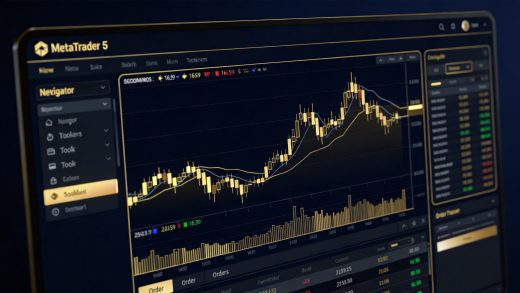


The shoe dropped — and nobody exhaled. In the early hours of October 29 (Beijing time), the Federal Reserve held the federal funds rate at 3.75%-4.00% in a 10-2 vote, with Governor Lisa Cook and Cleveland Fed President Beth Hammack dissenting in favor of an immediate 25bp hike. Gold managed only a token 0.18% bounce on the decision, then ground lower for two sessions, slicing back below $4,000 in Asian trading on October 30 with an intraday low of $3,996.6.
CME FedWatch now prices roughly an 80% chance of a 25bp December hike. A “split hold” plus a chair who refuses to commit means the battle for $4,000 on XAUUSD has officially entered its decisive phase.
Anatomy of the Decision: The 10-2 Vote and Three Statement Shifts
Compared with September’s unanimous 12-0 hike, the real signal in October is buried in the vote split: both dissents came from the hawkish side, which tells you the committee’s tolerance for elevated inflation is wearing thin. Three textual changes in the statement deserve a word-by-word read:
| Dimension | September Statement | October Statement | Signal |
|---|---|---|---|
| Vote | 12-0 unanimous hike | 10-2 hold, 2 dissents for a hike | Hawkish split goes public |
| Economy | “Solid pace” | “Strong pace” | Keeps the door open for more tightening |
| Inflation language | “This policy action will support a timely return to 2%” | Deleted; replaced with “more information will help determine the stance” | From commitment to observation — flexibility up |
Deleting the “support a timely return” line was the most quietly hawkish move in the statement — the Fed is no longer underwriting any single policy action, and every data print can now change the path. For quant traders, that directly raises the volatility expectation on every data day.
Warsh’s Three “No’s” and an Underrated Overhaul
At the press conference, Chair Kevin Warsh declined to offer any forward guidance, stressed that “there is no soft inflation target,” and denied that the October pause had anything to do with the midterm elections. He also floated that Q3 GDP growth may exceed 3% with business investment possibly running at a double-digit pace — the backbone behind the statement’s upgraded “strong” language.
The genuinely under-covered story is the institutional overhaul: starting in 2027, some FOMC meetings will discuss long-term strategy only — no vote, no statement (one such meeting in 2027, two in 2028). Fewer decision points systematically amplify the weight of every Warsh speech and every inflation print in 2027. Expect the market’s sensitivity to his words to be structurally magnified.
A historical footnote worth knowing: since the 1990s, the Fed has never delivered consecutive October hikes in a midterm-election year. This pause validates that nearly 40-year-old unwritten rule once again.
The Yield Curve Is Telling the Real Story
The bond market’s reaction carried more information than gold itself: the 2-year Treasury yield fell 3bp to 4.67%, while the 10-year and 30-year rose 6bp and 7bp to 5.05% and 5.37% — a textbook bear steepener. The front end is pricing the pause; the long end is pricing “higher for longer” plus fiscal credibility risk. The dollar index slipped just 0.2%, a clear sign the market doesn’t believe the tightening cycle is finished.
For gold, that combination is “short-term relief, long-term pressure”: the pause removes the immediate threat, but rising long-end real yields keep compressing valuations. That is exactly the pricing logic behind gold’s “token pop, then slow bleed” after the decision — the October 30 low of $3,996.6 sits one step above the $3,975 double-bottom defended on October 27.
The $4,000 Level: Anatomy of a Third Assault
This is gold’s third real test of $4,000 in October: the first break on October 23 (first time since July), a successful double defense of $3,975-$4,000 with a V-shaped reversal on October 27, and another break on October 30 after the decision. The level keeps changing hands, which tells you it is neither a floor nor a vacuum — it’s the turnover zone where bulls and bears swap inventory.
The institutional split is instructive. Chinese state-affiliated analysis points to central-bank buying (the PBoC has added for 23 straight months, 103 tonnes year-to-date) as a three-layer “allocation, credit, and strategic” floor, expecting a consolidation above $4,000 and a repair toward $4,200 over the next two months. Sucden Financial warns of a $3,900 test before the December meeting, while State Street trimmed the probability of its Q1 2027 $4,750-$5,500 scenario from 70% to 60%. The real line in the sand below is the prior London low at $3,940-$3,950 — a decisive break there triggers a stop-loss and deleveraging cascade.
Next Week’s Event Cluster and Three Tactical Approaches
Next week packs rare catalyst density: the U.S. midterm elections on November 3, the Bank of England decision on November 5, and the October jobs report on November 6 (note: U.S. daylight saving ends November 1, shifting release times one hour later in UTC). Consensus expects roughly 50k new jobs — better than September’s dismal 29k but still weak — with unemployment steady at 4.2%. October CPI follows on November 10.
| Scenario | Trigger | Gold Path | Response |
|---|---|---|---|
| Base (~55%) | NFP 30-80k, no midterm surprise | $3,975-$4,070 grinding range | Range-trade at 50% size |
| Hawkish (~30%) | Hot NFP or fiscal-easing election repricing | Break of $3,975 targets $3,940-$3,950 | Follow the break toward $3,900 |
| Dovish (~15%) | NFP below 20k or unemployment jumps | Reclaim $4,070, challenge $4,130 | Buy dips, stop below $3,975 |
Tactic one: de-lever into the events. Election night and the NFP release are the thinnest liquidity windows of the month. Cut total exposure to 40-60% of normal and probe with micro-lots instead of committing full size at once.
Tactic two: fade the NFP knee-jerk. September’s 29k print failed to stop gold’s slide — single labor data points have been subordinated to the inflation-hike master narrative. If the first 15-minute candle on NFP night diverges from the rate-expectation logic, trade the reversal, not the headline.
Tactic three: stress-test execution quality. In catalyst-dense weeks, spreads and slippage are part of your strategy’s P&L. I’ve run news-impulse sessions on ECMarkets’ ECN account for years; spreads stayed within a sane band during decision-night sweeps, which is the precondition for any rapid-rebalancing approach to work.
Frequently Asked Questions
Why didn’t the Fed hike in October?
Three reasons: it needed time to assess September’s 25bp hike; the near-40-year convention of staying politically neutral before midterms; and Chair Warsh’s determination to preserve December flexibility rather than be hostage to market pricing. But the 10-2 vote shows the hawks are nearing critical mass.
What does an 80% December hike probability mean?
With pricing near 80%, a December hike as expected delivers limited shock — it merely validates the known path. The real risk is a surprise hold, which would trigger a fast drop in Treasury yields and the dollar and a sharp gold rally. Both tails are asymmetric; heavy one-way bets offer poor value here.
Where is support after gold lost $4,000?
First support is $3,975 (the October 27 double bottom), then $3,940-$3,950 (the prior London low and bull-bear dividing line), with $3,900 as the extreme case. Resistance sits at $4,070, then $4,130.
How do the midterms affect gold?
Volatility historically spikes in the results week. If the outcome lifts fiscal-easing expectations, long-end yields could rise further — a short-term headwind for gold. But political uncertainty itself is a medium-term source of safe-haven demand: short-term bearish, structurally supportive.
For the pre-decision order-book structure, read FOMC Eve V-Reversal: Gold Reclaims $4,000 as the $3,975 Double Bottom Holds Twice. For the full “near-dove, far-hawk” rate-path framework, see Fed on Hold in October, But a 92% December Hike Is Priced. Gold enters its traditional strong season in November — the data is in Gold Seasonality Explained: 50 Years of XAUUSD Monthly Win Rates.
About the author: Dongyi Guo, professional quantitative trader focused on XAUUSD gold strategy research and live trading, running Dongyi Finance and sharing quantitative strategies and in-depth market analysis.
Contact: Telegram: @DongyiTrade
ECMarkets Exclusive Invitation
Register through Dongyi’s exclusive invitation link and enjoy a 30% trading rebate, permanently. MT4/MT5 supported, copy-trading available for my XAUUSD quant strategy — a minimum deposit of $1,000 activates the exclusive benefits.
Open Your 30% Rebate Account →
Invitation link: https://i.ecmarkets.com/api/client/pm/2/793EN