

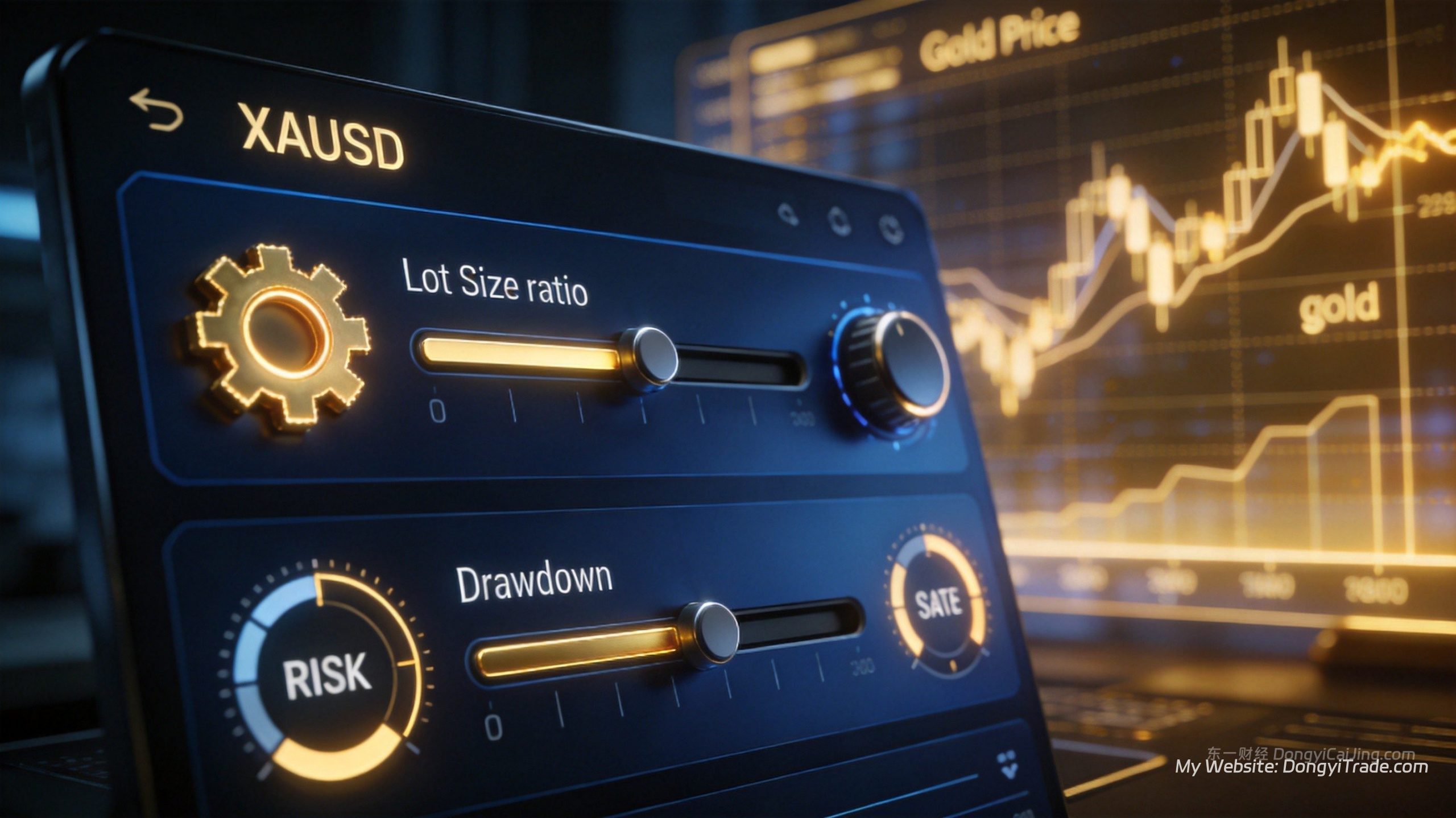
The core conclusion on XAUUSD copy trading settings: your lot ratio determines your return elasticity, but your drawdown limits determine whether your account survives. Start at 0.5x, cap total account drawdown at 20%, and never risk more than 2% of equity on a single copied trade.
Why Settings Determine 90% of Your Copy Trading Outcome
Two accounts copying the exact same signal provider can end the year with opposite results. One finishes up 7%, the other gets stopped out entirely. The difference is never the signal — it’s the parameters wrapped around it.
According to risk disclosure data published across FCA-regulated brokers, 74-89% of retail trading accounts lose money. In copy trading specifically, the majority of those losses come not from bad signal providers but from leverage stacking and parameter mismatch.
September 28, 2026 offered a live stress test. When XAUUSD flash-crashed 4% intraday — a $180 swing from $4,290 down to $4,110 — accounts copying at 2x ratios or higher hit forced liquidations in waves, while accounts running 0.5x-1x ratios absorbed the move and kept trading.
Parameter configuration comes down to three dimensions: lot sizing, drawdown defense, and per-trade risk. Let’s break each one down, then finish with three battle-tested templates you can deploy today.
Lot Sizing: Three Modes Compared
The lot ratio is the first parameter every copy trading system asks for, and it directly scales your P&L volatility. The three mainstream modes each fit a different use case.
Fixed Lot Mode
Regardless of what size the signal provider trades, your account always executes a fixed volume — say 0.1 lots, every time. Your risk per trade never changes. This mode is ideal for small accounts and for the validation phase when you’re still testing a new provider.
Ratio Mode
Your trades scale proportionally to the provider’s. At 0.5x, when they trade 2 lots you trade 1. At 2x, you’d trade 4. This mode mirrors the provider’s rhythm exactly and is the most widely used — and the mode we recommend for most copiers once trust is established.
Equity-Proportional Mode
The system auto-calculates your lot size based on the ratio of your equity to the provider’s. If they run $100k and trade 1 lot, your $10k account automatically trades 0.1. Theoretically the most elegant mode — but it requires the provider to publicly verify their real equity, which limits where it can actually be used.
| Dimension | Fixed Lot | Ratio Mode | Equity-Proportional |
|---|---|---|---|
| P&L controllability | Very high | Moderate | High |
| Sync with provider | Low | High | High |
| Capital efficiency | Low | Moderate | High |
| Best for | Beginners validating a provider | The majority of copiers | Large accounts, multi-signal portfolios |
| Recommended starting value | 0.05-0.1 lots | 0.5x | Automatic |
Drawdown Defense: Three Layers You Must Set
Drawdown control is your account’s lifeline. You can always switch signal providers — but you can’t trade your way back from zero. A professional copy trading setup includes all three of the following layers.
Layer 1: Account-Level Drawdown Kill Switch
Set a hard account drawdown limit at 20%. When equity falls 20% from its peak, the system stops copying new orders and flattens all open positions. The logic is simple: preserve 80% of your capital so you always have the ammunition to restart with a better provider.
Layer 2: Provider-Level Drawdown Monitoring
Any signal provider with a historical max drawdown above 30% should be excluded outright. During live copying, if the provider’s running drawdown reaches 1.5x their historical maximum, disconnect manually and reassess. A provider whose worst historical drawdown is 15% gets cut off at 22.5% — no exceptions.
Layer 3: Daily Loss Circuit Breaker
Cap daily losses at 5% of account equity. On event days like NFP or FOMC, XAUUSD routinely swings more than $100 in a session. A circuit breaker stops a cascade of stop-outs from gutting the account in a single afternoon.
Per-Trade Risk: Stop Mapping and Position Caps
Beyond account-level defenses, three trade-level parameters deserve the same discipline.
First, forced stop-loss mapping. Some providers trade naked without stops — your copy system must have “force attach stop-loss” enabled. For XAUUSD, a $30-$50 stop distance fits hourly strategies; swing strategies can stretch to $80-$100.
Second, maximum concurrent positions. Cap simultaneous positions from a single provider at 3. Martingale-style providers will keep adding to losers to average down, and without a position cap, floating losses scale geometrically in trending markets. To spot these providers early, use the five-step filter in our copy trading beginner’s guide.
Third, slippage tolerance. Set maximum acceptable slippage at 3-5 points. Copy execution typically lags 0.5-2 seconds behind the master account, and slippage expands dramatically in fast markets. An order that slips beyond your tolerance is an order better left unfilled.
Three Proven Parameter Templates
Based on risk appetite and account size, here are three configurations validated on live accounts. Deploy them as-is or use them as your baseline for adjustment.
| Parameter | Conservative | Balanced | Aggressive |
|---|---|---|---|
| Suggested capital | $1,000-$2,000 | $2,000-$5,000 | $5,000+ |
| Lot mode | Fixed 0.05-0.1 lots | 0.5x ratio | 1x-1.5x ratio |
| Account drawdown limit | 15% | 20% | 25% |
| Daily loss breaker | 3% | 5% | 8% |
| Per-trade stop distance | $30 | $50 | $80 |
| Max concurrent positions | 1 | 3 | 5 |
| Number of providers | 1 | 2 (low correlation) | 3 (diversified) |
| Expected monthly return | 2%-5% | 5%-10% | 10%+ (high risk) |
One rule binds all three templates: the account drawdown limit never exceeds 25%. The math is unforgiving — a 25% loss requires a 33% gain to recover; a 50% loss requires 100%. The tighter your drawdown control, the more durable your long-term compounding.
The balanced template fits most traders. Take a $2,000 account copying a provider with a 15% historical max drawdown at 0.5x — your expected account-level drawdown lands around 7.5-10%, leaving real breathing room. For the position sizing math behind this, see our position sizing complete guide.
The Five Fatal Parameter Mistakes
Mistake one: raising the ratio right after a winning streak. This is the number one account killer in copy trading. The correct protocol is to increase the ratio only after every 20% of cumulative profit, by no more than 0.25x at a time, with a fresh two-week observation period after each change.
Mistake two: copying multiple highly correlated providers. Three XAUUSD trend-following providers look diversified but bleed together in a drawdown. Keep pairwise strategy correlation below 0.5, measured on 30-day return series.
Mistake three: ignoring spread and commission drag. Some providers win often but skim thin margins per trade — on a wide-spread account, costs eat the entire edge. Keep XAUUSD spreads under 0.3 and verify that combined costs stay below 30% of the provider’s average per-trade profit.
Mistake four: never reading the equity curve shape. A smooth, upward-sloping curve is copyable; a jagged curve with vertical spikes is not, no matter how high the total return. Watch the most recent 90 days closely — a sudden steepening of the curve often precedes strategy decay.
Mistake five: set-and-forget. Market regimes shift, and so do providers. Review parameter effectiveness weekly and run a full provider evaluation monthly. If you’re newer to this workflow, our copy trading beginner’s guide walks through the complete process step by step.
Pre-Launch Checklist
Before you flip the switch on live copying, verify every item below. All boxes checked — then start.
- Provider’s verified 12-month max drawdown is under 30%, with auditable trade history
- Account-level drawdown kill switch is set and capped at 25% or lower
- Daily loss circuit breaker is set at no more than 5% of equity
- Forced stop-loss mapping is enabled, with distances matched to your risk tolerance
- Max concurrent positions are capped to contain averaging-down strategies
- Cost check complete: spread plus commission is under 30% of the provider’s average per-trade profit
- Demo or small-live validation run completed for at least 2 weeks, confirming acceptable latency and slippage
Frequently Asked Questions
What copy ratio should I start with?
Start at 0.5x — the sweet spot between risk and reward. If the provider draws down 15%, your account only absorbs about 7.5%, which most traders can sit through emotionally. After three consecutive months with your account drawdown under 10%, step up gradually to 0.75x-1x. Never exceed 2x under any circumstances.
What if my provider suddenly increases their lot size?
Investigate immediately whether they’ve changed strategies or loosened risk controls. If a single position exceeds 3x their historical average size, disconnect manually and observe. Sudden size jumps usually signal averaging-down behavior or a shift to martingale — both are red flags you don’t want leveraged into your account.
How much capital do I need to start copy trading?
We recommend a $2,000 minimum. Below that, two problems emerge: the 0.01-lot minimum step makes precise ratio mapping impossible, and your cushion against normal drawdowns gets too thin to survive psychologically. $2,000 at 0.5x comfortably absorbs XAUUSD’s routine $50-$80 daily swings.
Can I diversify across multiple signal providers?
Yes — but correlation control is non-negotiable. Combine 2-3 providers with genuinely different strategy types, such as one trend system plus one mean-reversion system. The portfolio-level drawdown limit still caps at 25%, and each provider’s capital allocation should be inversely proportional to their historical drawdown.
When should I stop copying a provider?
Three triggers demand action: running drawdown hits 1.5x their historical maximum; win rate over the last 20 trades falls more than 15 percentage points below their long-run average; or trading style shifts abruptly — holding times stretching out or position sizes jumping. When you switch, validate the new provider small before committing real size.
—
**About the Author:** Dongyi Guo is a professional quantitative trader specializing in XAUUSD gold quantitative trading and strategy development.
**Contact:** Telegram @DongyiTrade
—
ECMarkets is a regulated global forex broker built for copy traders:
- ✅ ECN Direct Execution — Millisecond fills keep copy slippage minimal
- ✅ Ultra-Low Spreads — XAUUSD from 0.12, so costs never eat your copied edge
- ✅ Full EA Support — Seamless MT4/MT5 copy systems and automated strategies
- ✅ Minimum deposit just $1,000 — Start professional copy trading with accessible capital