
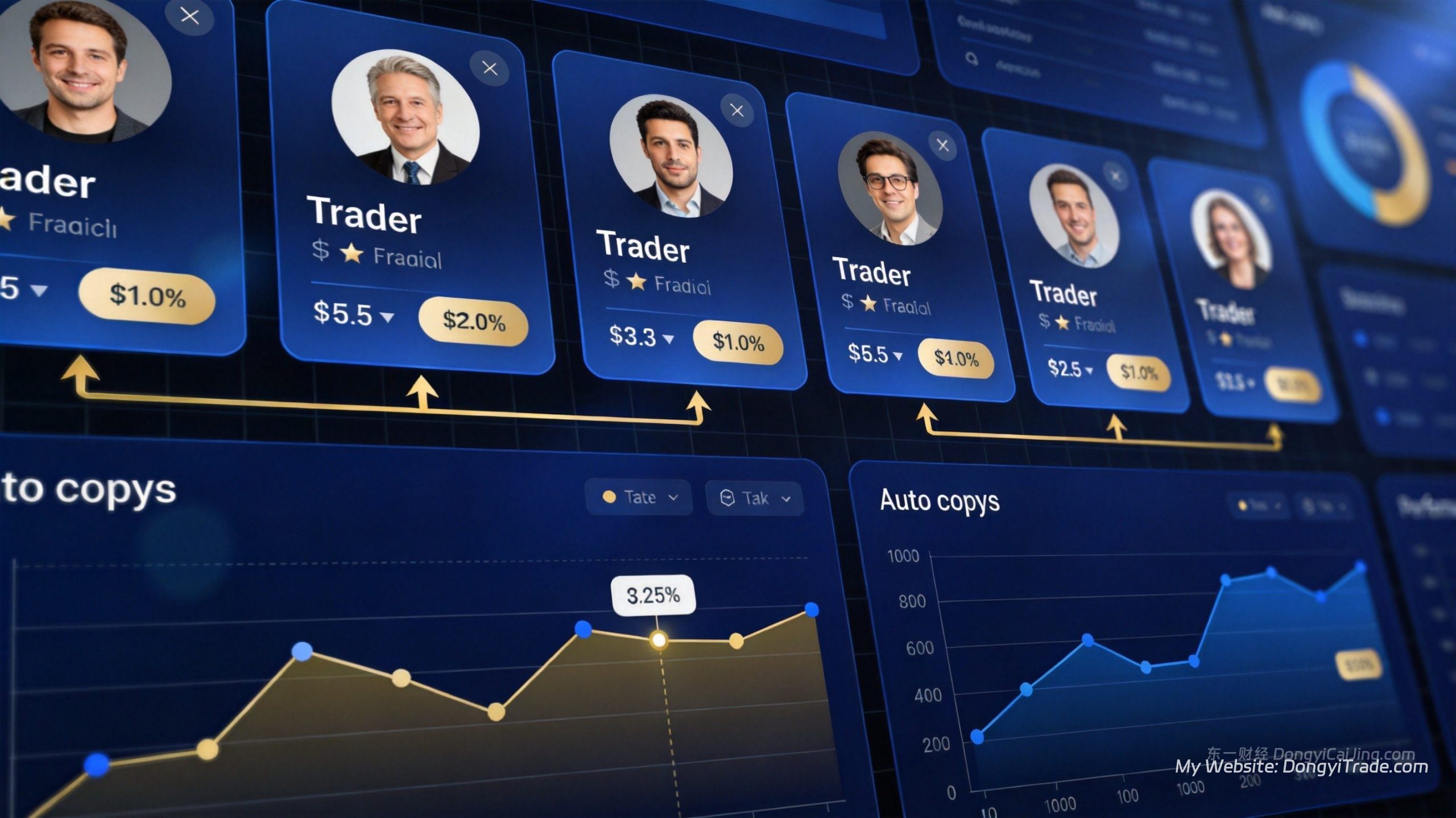
Copy trading is a passive investment approach where you automatically replicate the trades of professional market participants. According to IntelMarket Research, the global social trading platform market reached $3.54 billion in 2025 and is projected to grow to $8.55 billion by 2032, representing a 13.4% compound annual growth rate.
Yet data shows that 78% of copy traders lose money within their first three months. The problem isn’t the model itself — it’s that most newcomers lack systematic selection criteria and a proper risk management framework.
This guide walks you through the complete knowledge system for copy trading, helping you avoid the mistakes that trap 80% of beginners.
Understanding the Mechanics: Replicating Strategy, Not Luck
The core mechanism is straightforward: you select a signal provider (master trader) on a platform, and the system automatically mirrors their positions in your account proportional to your capital. Exits are synced automatically as well.
But this doesn’t mean passive profits. According to eToro’s 2025 transparency report, copiers following the top 10% of performers averaged 18.7% annual returns, versus a platform-wide average of just 4.2%. Who you choose to copy — and how you manage the process — determines whether you land in the profitable 25% or the losing 75%.
The real value of copy trading lies in reducing information asymmetry. Signal providers trade with real capital, and their track records represent the most authentic strategy demonstration available — far more credible than any course, book, or demo account.
The 5-Step Selection Framework: Finding Providers Worth Following
According to a 2025 University of Cambridge study on crypto social trading, signal providers who offered detailed strategy explanations saw 27% lower follower attrition rates. Transparency is a meaningful quality indicator.
Step 1: Demand at Least 12 Months of History
Track records shorter than 12 months carry no statistical weight. Short-term high returns often reflect luck or excessive risk-taking. According to eToro data, traders with over 12 months of verified records showed 34% lower volatility.
Ideally, review 18-24 months of complete history covering different market conditions — trending, ranging, and black-swan events.
Step 2: Prioritize Maximum Drawdown Over Returns
Maximum drawdown (MDD) measures the largest peak-to-trough decline. A provider delivering 60% annualized returns with a 45% drawdown is considerably riskier than one generating 25% returns with a 12% drawdown.
| Metric | Quality Provider | High-Risk Provider |
|---|---|---|
| Annualized Return | 15-30% | 60-150% |
| Maximum Drawdown | ≤15% | 35-50% |
| Profitable Months | ≥65% | 50-60% |
| Average Hold Period | 3 days – 4 weeks | Hours – 1 day |
| Verified History | ≥18 months | <6 months |
Step 3: Confirm It’s a Live Account
Demo accounts carry no psychological pressure — providers trade completely differently without real capital at stake. Always verify the account type is labeled “Real.” Reputable platforms clearly distinguish between live and demo accounts.
Step 4: Analyze Trading Frequency and Strategy Type
High-frequency traders (multiple daily trades) generate more transaction costs and are susceptible to slippage, though they suit short-term copying. Low-frequency traders (1-3 trades per week) incur lower costs and are better for medium to long-term copying.
Step 5: Review Follower Community and Retention
An active follower community serves as social proof of credibility. Focus on the trend in follower count — sustained growth indicates existing copiers are satisfied with results.
Risk Management: Copying Doesn’t Mean Setting and Forgetting
According to Bybit’s 2025 loss analysis, 71% of users who suffered losses exceeding 50% had no stop-loss protection on their copied trades.
Core Risk Rules
Rule 1: Allocate no more than 30% of total capital to any single provider. Even if you’re highly confident in one trader, diversify across 3-5 providers with different strategies.
Rule 2: Set a copy trading stop-loss. Most platforms support maximum loss thresholds — I recommend 20-25% of allocated copy trading capital. When triggered, copying stops automatically.
Rule 3: Review provider performance monthly. Check key metrics regularly. If a provider underperforms their benchmark for three consecutive months or their style shifts significantly, consider reallocating.
Rule 4: Adjust leverage independently. If your signal provider uses high leverage (say 20x), you can choose to copy at lower leverage (10x). According to Bitget data, copiers using half the provider’s leverage reduced drawdown by approximately 36% while still capturing substantial returns.
Hidden Costs Most Beginners Overlook
Beyond explicit platform fees, copy trading carries several hidden costs:
Slippage: When thousands of followers simultaneously copy the same trade, later executors face worse entry prices. Data from major platforms shows slippage of 2-5 pips on large providers with 10,000+ followers.
Time Delay: Milliseconds of latency between the provider’s execution and your account can mean significant price differences during volatile moves.
Profit Sharing: Typically 10-35% of profits go to the provider. Your selected provider needs to generate sufficiently high gross returns for you to achieve satisfactory net profits after deductions.
From Copying to Independence: Building Your Own Trading System
The ultimate value of copy trading extends beyond earnings — it’s an education. According to OKX’s Q1 2026 report, users who engaged with community discussions before copying trades averaged 8.3% higher returns.
Recommended learning path: copy for 3-6 months while studying the provider’s logic → understand entry and exit signals → attempt executing similar strategies on small positions → gradually build your own system.
Platform data shows long-term copiers (18+ months) see loss rates drop to 30%, confirming that patience and discipline are the true keys to copy trading success.
FAQ
Is copy trading suitable for beginners?
Yes. The global social trading platform market reached $3.54 billion in 2025. However, 78% of copy traders lose money in their first three months, primarily due to poor provider selection and inadequate risk management.
How much do copy trading services cost?
Three cost layers: platform fees (0.5-2 pip spread markup), provider performance fees (10-35% of profits), and potential subscription fees ($10-50/month). ECMarkets charges no additional subscription fees.
How do you choose a reliable signal provider?
Focus on five metrics: minimum 12 months history, maximum drawdown under 20-25%, live account, transparent strategy, and positive follower reviews. Providers with 12+ months of verified records show 34% lower volatility (eToro 2025).
How much can you earn copy trading?
Based on multi-platform data, 25-35% of long-term copiers earn above 15% annually, 40-50% break even, and roughly 20% lose more than 20%. Results depend on provider selection, risk diversification, and holding period.
Is copy trading better than trading independently?
Both have advantages. Copy trading suits time-constrained or less experienced investors. Self-trading fits those willing to learn analysis. According to Chainalysis 2025, users who combined community analysis with copying saw 31% lower drawdowns.
Final Thoughts
Copy trading is a powerful tool, but it’s not a money-printing machine. Success requires systematic provider screening, strict risk management, and continuous performance monitoring.
Remember: in copy trading, your core job isn’t analyzing charts — it’s analyzing signal providers. Treat provider selection with the same rigor as selecting a fund manager, and you’ll outperform 80% of copy traders.
I’m Dongyi Guo, focused on XAUUSD quantitative trading and copy trading strategy research. Feel free to connect via Telegram @DongyiTrade.