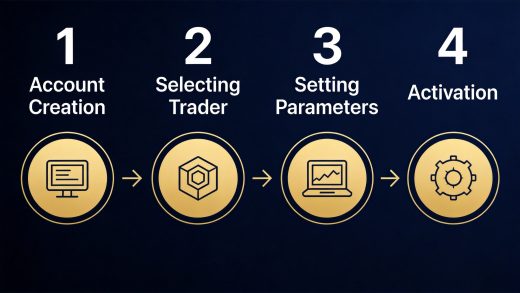


Most people start copy trading, pick a trader, hit “copy,” and never touch the settings again. This is a mistake. The default copy trading parameters are rarely right for your specific situation. A 50-year-old retiree with a $100,000 account needs completely different settings than a 25-year-old with a $2,000 account.
In this guide, I’ll walk you through every important copy trading parameter, explain what it does, and tell you exactly how to set it based on your risk tolerance and account size.
The Most Important Parameter: Lot Multiplier (or Ratio)
The single most important setting is the lot multiplier (sometimes called “copy ratio” or “investment ratio”). This controls how much of your account gets allocated to each copied trade.
How it works: If the trader risks 1% of their account per trade and you set a 1:1 ratio, you also risk 1% of your account per trade. If you set a 0.5x ratio, you risk 0.5%. If you set 2x, you risk 2%.
Rule of thumb: Start with a ratio that gives you roughly 0.5-1% risk per trade. That’s a safe starting point.
But here’s the catch — not all copy platforms calculate the ratio the same way. Some use fixed lot sizes, some use proportional risk, some use equity-based scaling. You need to understand exactly what your platform is doing.
How to verify: After you start copying, check the actual position size of the first copied trade. Calculate what percentage of your account the trade’s stop loss represents. If it’s more than you expected, adjust the ratio down. Never assume the default is correct.
| Risk Profile | Recommended Ratio | Typical Max Drawdown |
|---|---|---|
| Conservative | 0.3x – 0.5x | 5-10% |
| Moderate | 0.7x – 1.0x | 10-20% |
| Aggressive | 1.2x – 1.5x | 20-30% |
| Very Aggressive | 2.0x + | 30%+ (DANGEROUS) |
My recommendation for beginners: Start at 0.5x. Run it for 3 months. If you’re comfortable with the drawdowns and you understand the strategy, you can slowly increase to 0.75x or 1.0x. Never start at 1x or higher — you don’t know what you’re getting into yet.
Daily/Weekly Loss Limits
This is the most underused parameter in copy trading. Most platforms let you set a maximum daily or weekly loss — if the copied trades hit that limit, copying automatically stops.
You should absolutely use this feature. Here’s why: even the best traders have bad days. If your trader has a meltdown day and loses 10% of their account, do you really want to lose 10% of yours before you even notice?
Recommended settings:
– Daily loss limit: 3-5% of your account. If the copy trading loses 3-5% in a single day, something is probably wrong — either the trader is having a bad day or their strategy has changed. Stop copying and investigate.
– Weekly loss limit: 7-10%. If you’re down 10% in a week, that’s way outside normal strategy behavior. Pause copying and review what happened.
Think of this as your emergency brake. It’s there to protect you from the worst-case scenarios. And yes, sometimes it’ll trigger on a normal drawdown and you’ll miss the recovery. That’s OK — missing one recovery is better than blowing your account on one bad week.
Maximum Number of Open Positions
This setting limits how many open trades the copy trading can have at once. It’s useful for two reasons:
- Risk control. If the trader takes 5 trades and they’re all correlated (e.g., all long USD), you’re actually taking one big bet with 5x the risk.
- Margin management. More open positions = more margin used = higher risk of a margin call if things go wrong.
Recommended: 3-5 positions maximum. Most good traders don’t need more than 3-5 positions at a time anyway. If your signal provider regularly has 10+ open trades, they’re probably overtrading, and you might want to reconsider following them.
Stop Out Level (Equity Stop)
Some copy trading platforms let you set a total equity stop — if your account drops to a certain level, all positions close and copying stops. This is your “last line of defense” setting.
How to set it: Decide the absolute maximum you’re willing to lose on this copy trading experiment. Set the stop out level there.
For example, if you deposit $5,000 and the most you’re willing to lose is $1,500 (30%), set the equity stop at $3,500. If things go that badly, you walk away with $3,500 instead of potentially losing much more.
Recommended: Set it at the 20-30% loss level. If you lose 30% copying someone, the strategy probably isn’t working for you, and you should stop and reassess.
Copy Settings: What Gets Copied?
Some platforms let you choose which types of trades to copy:
- Market orders only vs. pending orders: I recommend copying both, but make sure you understand the trader’s pending order strategy.
- Stop losses and take profits: ALWAYS copy stop losses. If your platform doesn’t copy SL/TP automatically, that’s a problem — you could end up in trades with no risk management.
- Adding to positions (pyramiding): Some traders add to winning positions. This amplifies gains but also increases risk. If you’re conservative, you might want to disable position adding.
- Closing partial positions: Make sure partial closes get copied too — otherwise you might be holding a position the trader already scaled out of.
Advanced: Custom Risk Multipliers Per Strategy
If you’re following multiple traders (which I recommend for diversification), you don’t need to use the same risk ratio for all of them.
For example:
– Trader A (conservative, low drawdown): 1.0x ratio
– Trader B (aggressive, high return): 0.5x ratio
– Trader C (experimental, new track record): 0.25x ratio
This way, your total portfolio risk is spread across strategies with different risk levels, and you’re not overexposed to any single approach.
Total portfolio rule of thumb: The sum of all your copy trading risk ratios should be between 1.0x and 2.0x total. So if you follow two traders at 1x each, that’s 2x total — you’re roughly doubling the risk of following just one. Keep it reasonable.
The Settings I Use Personally
For my own copy trading allocations (yes, I copy other traders too — diversification is important), here’s what I use:
| Parameter | Setting |
|---|---|
| Primary (proven) trader | 0.75x ratio |
| Secondary (different strategy) trader | 0.5x ratio |
| Daily loss limit | 4% |
| Weekly loss limit | 8% |
| Max open positions | 4 |
| Equity stop out | -25% |
| Copy pending orders | Yes |
| Copy partial closes | Yes |
| Pyramiding | Enabled (for trend strategies only) |
I keep the ratios below 1x because I already have my own trading, and I don’t want the copy trading to dominate my portfolio. It’s a diversifier, not the main event.
Before You Start: The 24-Hour Test
Here’s a pro tip: after you set up copy trading, don’t just walk away. Watch it for 24 hours. Check the first trade. Verify that:
- The position size is what you expected (not too big or too small)
- Stop losses and take profits are being copied correctly
- The trade matches what the provider took (same entry, same direction)
- Your account balance is changing as expected
Platform glitches happen. Settings get misinterpreted. Brokers have technical issues. It’s better to catch these problems after one small trade than after a 10% drawdown.
The Bottom Line
Copy trading settings aren’t “set it and forget it.” The right parameters today might not be right in 6 months when your account size changes, your risk tolerance changes, or the trader’s strategy changes.
Review your copy trading settings once a month. Check the actual risk you’re taking. Make sure it still aligns with your goals and your comfort level. And if something doesn’t feel right — turn it off.
Copy trading is supposed to make your life easier, not give you more stress. Get the parameters right from the start, and you’ll be way ahead of most people who just click “copy” and hope for the best.
Want help setting up copy trading with my signals? Message me on Telegram @DongyiTrade or email contact@dongyitrade.com and I’ll walk you through the optimal settings.