
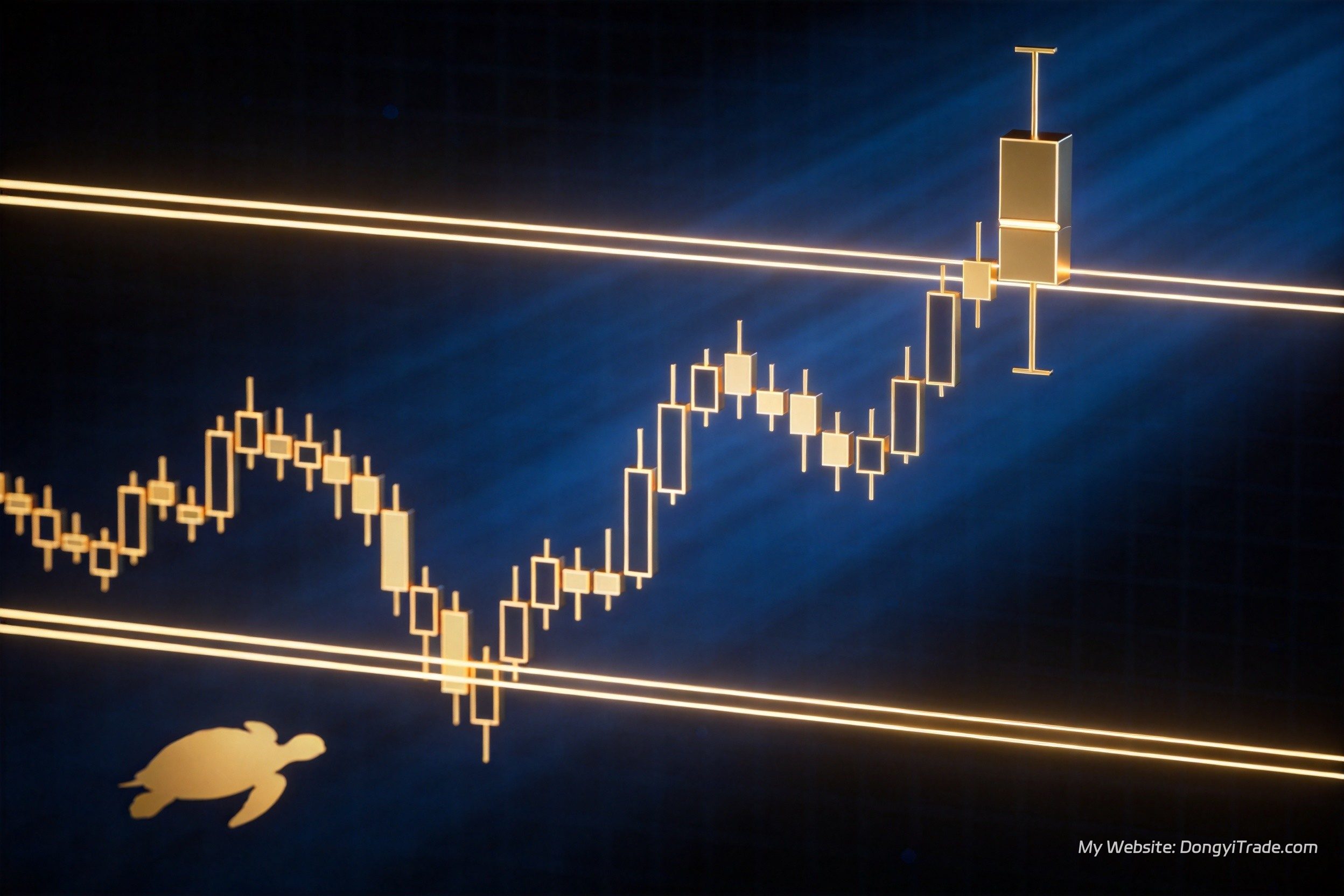
In 1983, Chicago trader Richard Dennis and his partner William Eckhardt made the most famous bet in trading history: can trading be taught? They picked 23 novices from a stack of applications, trained them for two weeks, and handed each of them real money. Five years later, the group known as the Turtles had earned roughly $175 million. The core entry signal of the system they learned is almost offensively simple — buy when price exceeds the highest high of the last 20 days, sell when it breaks the lowest low. The indicator behind that signal is the Donchian Channel.
With gold boxed in a $3,850-$4,000 range and momentum indicators whipsawing by the week, going back to the oldest trend tool in the book turns out to clarify what most modern indicators are really doing.
Origins: From the Father of Trend Following to a Famous Experiment
Richard Donchian is widely called the father of trend following: in 1949 he launched Futures, Inc., the first publicly managed futures fund in the United States — predating most technical indicators entirely. His channel is brutally simple in construction: the upper band is the highest high of the last N bars, the lower band is the lowest low, and the middle line is the average of the two. No smoothing, no weighting, no standard deviations. Just naked extremes.
That “dumb” indicator became the skeleton of the Turtle system. Dennis, himself a trend-following believer, built both of the systems he taught on Donchian logic: System One entered on 20-day breakouts; System Two used 55-day breakouts to backstop major trends. The experiment’s real lesson was never that the indicator was clever — it was that a simple rule set plus iron discipline beats the majority of discretionary traders.
The Original Turtle Rules: A Channel Turned Into a System
A channel by itself is just a drawing tool. The Turtle contribution was to regulate everything around it — entry, filtering, stops, pyramiding and sizing. The core original parameters:
| Module | System One (fast) | System Two (slow) |
|---|---|---|
| Entry | Long on a break above the 20-day upper band; short below the lower band | Long/short on 55-day channel breaks |
| Filter | Skip the signal if the last 20-day breakout was a winner | No filter — every signal must be taken |
| Stop-loss | 2N from entry (N = 20-day ATR) | Same |
| Pyramiding | Add one unit every 0.5N of profit, max four units | Same |
| Risk per unit | One unit = 1% of equity ÷ (N × dollar value per point) | Same |
| Exit | Opposite break of the 10-day channel | Opposite break of the 20-day channel |
Three design details deserve slow reading. First, the skip-after-a-winner filter: the greatest enemy of breakout systems is a string of false starts, so this rule deliberately sacrifices some signals to cut the bleed — and if a skipped breakout becomes a real trend, the 55-day system catches it anyway. The problem is solved structurally, not by prediction. Second, everything is priced in N: stop distance, add spacing and unit size all anchor to the same volatility yardstick, so the system rescales itself in any volatility regime. For the mechanics of ATR-based sizing, see our ATR masterclass. Third, the exit channel is shorter than the entry channel — a 20-day entry pairs with a 10-day exit — an asymmetry built to protect open profit.
Adapting It to XAUUSD: Gold Parameters and the Live Channel Map
Copy-pasting the original rules onto gold fails out of the box. XAUUSD is a news-driven instrument — payrolls, CPI and Fed speak routinely print $50-$100 one-day spikes, so the false-breakout density on a 20-day channel is far higher than in commodity futures. The gold adaptation:
| Parameter | Turtle original | XAUUSD adaptation | Why |
|---|---|---|---|
| Entry channel | 20-day / 55-day | 20-day primary; 55-day as trend confirmation | Gold trends persist; keep the dual structure |
| Breakout confirmation | Intraday touch triggers entry | Require a daily close beyond the band | Filters data-release spike fakes |
| Auxiliary filter | Skip after a winning breakout | Allow entries only when ADX is above 25 | Mutes signals in trendless chop |
| Stop-loss | 2N | 1.5-2N; tighten before major events | Gold gaps overnight more than commodities |
| Pyramiding | Every 0.5N, up to four units | Conservative: every 1N, up to three units | Caps one-direction exposure |
Now the persuasive part — what the tool says about today’s tape. As of November 4, XAUUSD’s 20-day Donchian channel has its upper band near 4190 (the October 19 high at 4190.27) and its lower band around 3869-3880 (the October 31 low at 3869.30, the November 2 low at 3880.11). Price sits near 3947, in the lower third of the channel. In plain language: a long breakout needs another ~6.2% of upside to trigger, while a short needs only ~2% of downside — the channel itself is telling you there is no trend signal in either direction, and that the structure is asymmetrically bearish. That reading cross-confirms the low-ADX “no trend” verdict from our ADX masterclass.
Filtering False Breakouts: Four Sieves for Gold
A breakout system’s profit lives in trends; its survival lives in filtering fakes. Run the four sieves in order. One, close confirmation — only a daily close beyond the band counts; intraday spikes are ignored. Two, trend-strength filter — no trend entries unless ADX(14) is above 25; below 20, a channel break is almost certainly noise. Three, retest confirmation — add only after the first pullback holds the broken band; a breakout that cannot survive its own retest was never a breakout. Four, volatility self-adjustment — N updates with ATR in real time, so position size contracts automatically in high-volatility months.
One more state deserves respect: the flat channel. When the 20-day bands run parallel and compressed for weeks — exactly the current 3869-4190 shelf — the market is announcing consolidation, and breakout logic should go dormant. Fading the edges of the box becomes the high-probability trade until the bands open up. The channel’s hidden second use is telling you when not to use it.
FAQ
Should I use the 20-day or the 55-day parameter?
You don’t have to choose — the original Turtle system ran both in parallel. The 20-day system catches trends early but carries the skip-after-a-winner filter; the 55-day system takes every signal and exists to backstop major trends. Smaller accounts can run the 20-day system alone, but keep the close confirmation and ADX filter; treat the 55-day channel as the switch that decides whether heavy sizing is allowed at all.
What’s the difference between Donchian Channels and Bollinger Bands?
Completely different construction. Donchian uses N-period extremes (highest high and lowest low); Bollinger uses a moving average plus or minus standard deviations. That gives them opposite personalities: Donchian is a trend-breakout tool answering “has price entered new territory?”; Bollinger is a volatility tool answering “how far has price stretched from normal?”. Use Donchian in trends, Bollinger for mean reversion in ranges — mixing them up is the most common mistake.
Can Donchian Channels be used in a ranging market?
Not with breakout entries — most “breakouts” inside a box are fakes. But a flat channel is itself information: parallel, narrowing bands mean the market is consolidating, so switch to grid or mean-reversion tactics until the bands open and ADX reclaims 25. A good indicator issues signals; a great one also issues injunctions.
Why did the Turtles skip a signal after the previous breakout won?
It’s a behavioral patch for a structural weakness. Breakout systems bleed during the trial-and-error phase between range and trend; the skip rule forces trading frequency down exactly then. The cost is occasionally missing a real breakout, which is why the 55-day system backstops it — if a trend is big enough, the slower signal will still catch it. Better to earn less than to bleed out. That philosophy is shared by every trading system that survives.
About the author: Dongyi Guo, professional quantitative trader focused on XAUUSD gold strategy research and live trading, running Dongyi Finance and sharing quant strategies and in-depth market analysis.
Contact: Telegram: @DongyiTrade