
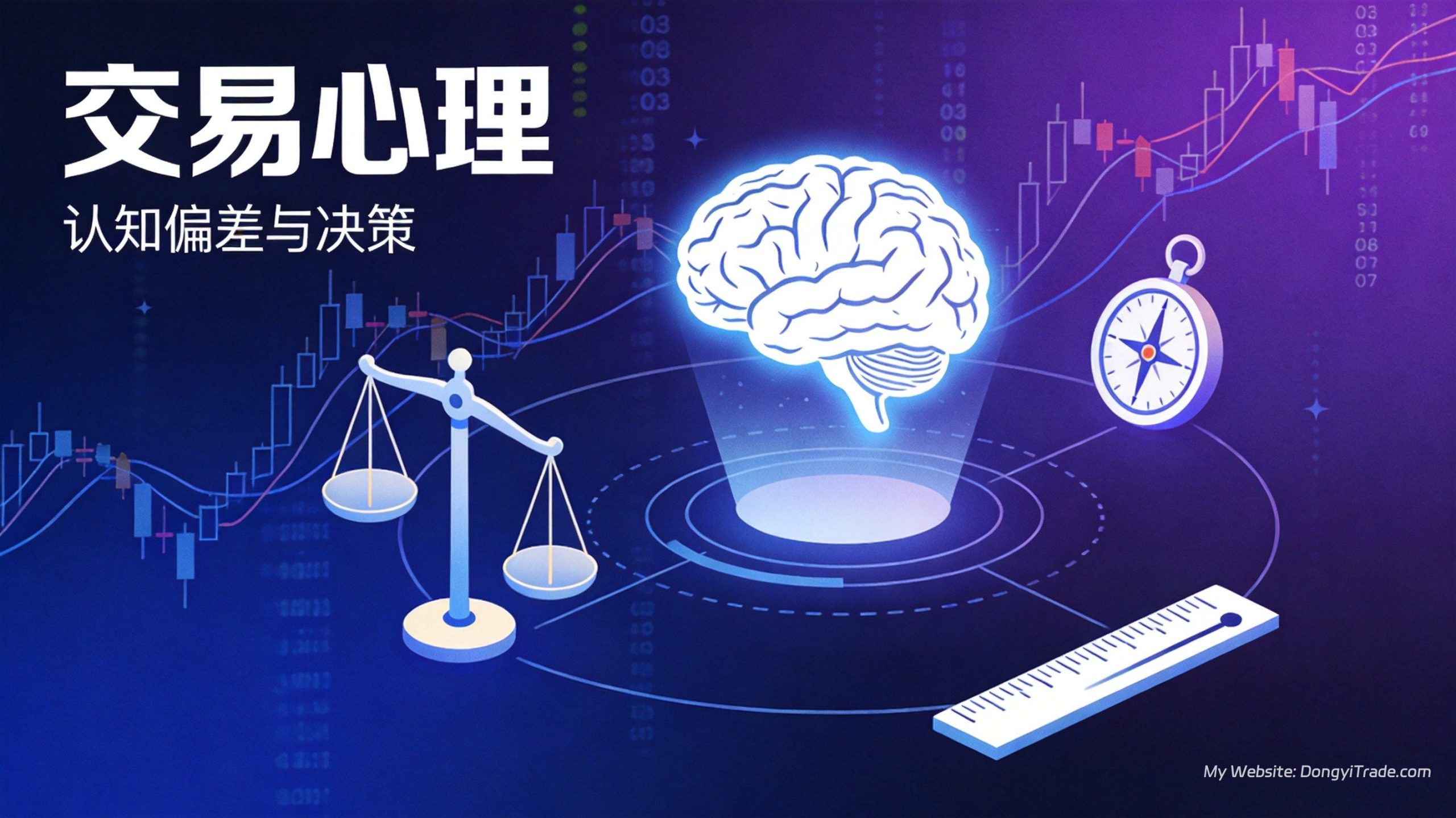
Here’s a sobering stat: 90% of trading losses aren’t caused by bad strategies – they’re caused by psychological biases. Behavioral finance research has shown that our brains are systematically wired to make poor decisions under uncertainty.
## What Are Trading Cognitive Biases?
Cognitive biases are systematic errors in judgment that occur when our brains process information. Nobel Prize winner Daniel Kahneman introduced the concept of two thinking systems in his book “Thinking, Fast and Slow.”
System 1 (fast thinking) relies on intuition and heuristics, responding in about 0.25 seconds but prone to errors. System 2 (slow thinking) requires logical analysis – it’s more accurate but consumes more mental energy. In trading, our brains default to System 1, which is exactly when costly mistakes happen.
According to the 2024 Global Retail Trading Behavior Report, approximately 73% of retail trader losses can be attributed to psychological factors. Among professional trading teams, mental training accounts for over 35% of total development time – that tells you everything about how seriously the pros take this.
## Loss Aversion: Losses Hurt 2.5x More Than Gains Feel Good
Loss aversion describes how the pain of losing is psychologically about 2.5 times as powerful as the pleasure of gaining. In other words, losing $100 feels as bad as winning $250 feels good.
In trading, loss aversion manifests as taking profits too early while letting losses run. Statistics show that retail traders hold winning positions for only 38% as long as losing positions – a recipe for terrible risk-reward ratios.
Here’s a classic XAUUSD example: a trader sets a $5 stop-loss. When gold drops $4, they hesitate. When it breaks through their stop, they hold on. Eventually they’re forced out at an $18 loss. A planned $5 risk turned into a $18 disaster, all because of loss aversion.
**Solutions:**
– Define your stop before entering, and never move it against your position
– Think of stops as insurance premiums – normal business costs, not personal failures
– Keep a trading journal comparing “holding losses” vs “taking stops” over time
## Anchoring Bias: Are You Held Hostage by Your Entry Price?
Anchoring bias is the tendency to rely too heavily on the first piece of information we receive (the “anchor”) when making decisions. In trading, that anchor is almost always your entry price.
After buying gold, traders unconsciously treat their entry price as the “fair value” benchmark. When price drops, they think “it’s cheaper than my entry – I should average down.” That’s not trading; that’s anchoring bias in action.
Grid trading strategies exploit statistical mean-reversion patterns with data-backed parameters. Averaging down based on gut feeling? That’s just anchoring bias with extra steps.
Research shows that anchoring-driven averaging-down increases average drawdown by 47% for retail traders. The correct approach? Adjust your expectations based on market structure and technical signals, not the price you happened to enter at.
**Solutions:**
– Define exit conditions before entering – your entry price shouldn’t influence your exit decision
– Regularly ask yourself: if I were flat right now, would I enter at this price?
– Replace “get back to break even” thinking with independent technical analysis
## Confirmation Bias: You Only See What You Want to See
Confirmation bias is the tendency to search for, interpret, and remember information that confirms our existing beliefs while ignoring contradictory evidence.
In trading, this looks like: going long and only reading bullish news, shorting and only paying attention to bearish data. A 2024 study from Duke University’s Fuqua School of Business found that traders with strong confirmation bias hold positions 42% longer and lose 28% more than rational traders.
What makes it dangerous is that confirmation bias creates the illusion of being right. A string of small wins builds confidence, and then one big counter-trend move wipes everything out. This explains why so many traders can go 10-for-10 on winners and still blow up on the 11th trade.
This is exactly why proper risk management matters so much. You can’t eliminate confirmation bias from your brain, but you can build systems that limit the damage when it strikes.
**Solutions:**
– Write down 3 bearish reasons before every long position (and vice versa)
– Follow analysts with opposing views on purpose
– Keep a trading diary documenting your reasoning, then review it after the trade closes
## Overconfidence and Sunk Cost: Two Silent Killers
### Overconfidence
Overconfidence means overestimating your analytical abilities and the accuracy of your information. A famous survey found that 82% of drivers think they’re above average. Traders are no different.
Cornell University research found that the top 20% most active traders underperform the least active by 7 percentage points annually. Overconfidence leads to excessive trading, and all those commissions and slippage add up.
### Sunk Cost Fallacy
Sunk costs are expenses already incurred that can’t be recovered. Rational decisions should only consider future costs and benefits – but our brains struggle with this.
“I’ve already lost so much, I can’t quit now” – that’s sunk cost fallacy talking. The more you’ve lost, the harder it is to walk away, and the bigger the eventual blowup. Studies show that sunk cost-driven position holding accounts for roughly 45% of catastrophic trading losses.
## Five Cognitive Biases: Impact Comparison
| Bias | Main Symptom | Trading Impact | Frequency | Loss Multiplier |
|——|————-|—————-|———–|—————–|
| Loss Aversion | Cut winners early, ride losers | ★★★★★ | Very High | 2.5-4x |
| Anchoring | Obsessed with entry price | ★★★★☆ | High | 1.5-2x |
| Confirmation Bias | Only seek supporting info | ★★★★☆ | High | 1.3-1.8x |
| Overconfidence | Overtrade, oversized positions | ★★★☆☆ | Medium-High | 1.2-1.5x |
| Sunk Cost | Refuse to stop loss | ★★★★★ | Medium | 3-10x |
## Practical Framework: Replace Intuition with Systems
Behavioral finance research shows that willpower alone isn’t enough to overcome biases. What works is building systematic decision-making processes.
**Three-Step Framework:**
**Step 1: Pre-Trade Checklist**
– Is your entry based on objective data (not feeling)?
– Have you considered counter-evidence?
– Are stop-loss and take-profit levels set and accepted?
**Step 2: During-Trade Discipline**
– Never move your stop against your position (only trail in your favor)
– Never add to losing positions (unless your strategy explicitly calls for it)
– Set daily limits on trade count and maximum loss
**Step 3: Post-Trade Review**
– Record your emotional state during the decision
– Separate “good losses” (following rules) from “bad wins” (lucky breaks)
– Track the monthly cost of bias-driven mistakes
Data from the Trading Psychology Institute (2025) shows that traders who follow systematic processes improve annual returns by 23% on average while reducing max drawdown by 31%.
## Algorithmic Trading: Let Machines Handle Execution
The biggest advantage of MT4 EA automated trading isn’t that the strategy is necessarily better – it’s that execution is emotion-free. An EA follows its rules perfectly, with no hesitation, no fear, no greed.
But algorithmic trading has its own psychological traps. Strategy developers often fall into overfitting – tweaking parameters until they perfectly match historical data, only to fail in live trading. Studies show that about 60% of backtest-winning EAs fail within 3 months of live trading, and overfitting is the primary cause.
So even quants need mental discipline: resist the urge to over-optimize parameters, don’t interfere with running EAs, and accept normal drawdown periods as part of the process.
—
**About the author:** Dongyi Guo is a professional quantitative trader specializing in XAUUSD algorithmic strategies with real-money track records across multiple market regimes.
✈️ Telegram: @DongyiTrade
📧 Email: guodongyi1101@gmail.com