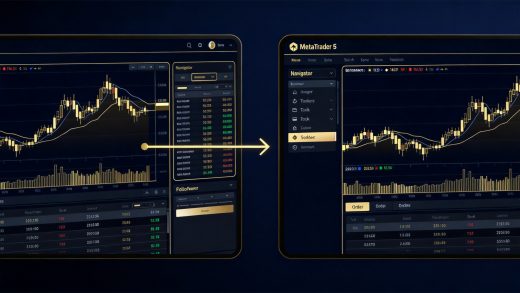

Forex Trading for Beginners: Complete 2026 Guide — 7 Steps to Start From Zero

New to forex? Follow these 7 steps: learn the market → pick a broker → practice on demo → master basic analysis → build a strategy → manage risk → start with small live capital. Take 3 months and your survival rate is 4x higher than jumping in blind.
## 1. How Big Is the Forex Market? 3 Key Numbers
Forex is the largest financial market on earth — by a wide margin. According to the Bank for International Settlements (BIS) Triennial Survey, global daily OTC forex turnover reached $9.6 trillion in April 2025, up 28% from $7.5 trillion in 2022. To put that in perspective, global stock markets trade roughly $300 billion per day — forex is 32 times larger.
Retail participation has exploded alongside institutional volume. Finance Magnates Intelligence data shows global retail forex and CFD monthly trading volume was approximately $30.4 trillion in Q2 2026. Asia leads the growth with roughly 3.2 million active traders, compared to about 1.5 million each in Europe and North America.
The US dollar dominates everything. It appears on one side of roughly 89% of all forex transactions. The dollar’s share of global central bank reserves stood at 57.13% in Q1 2026 (IMF data). EUR/USD, USD/JPY, and GBP/USD are the top three pairs, capturing nearly half of all global volume.
## 2. Step 1 — Understand 5 Core Concepts
Before you open any account, make sure you fully understand these five concepts. Skipping them is the fastest way to lose money.
**Currency pairs and quotes.** Forex always trades in pairs. Buying EUR/USD means buying euros while selling dollars. A quote of 1.0850 means 1 euro costs 1.0850 US dollars. The 4th decimal place (2nd for JPY pairs) is a “pip” — the smallest price movement unit.
**Leverage and margin.** Leverage is a double-edged sword. With 100:1 leverage, $1,000 controls a $100,000 position. A 1% price move equals a 100% account swing. Professional traders typically use only 5:1 to 10:1 effective leverage, no matter what the broker offers.
**Spreads and trading costs.** The spread is the difference between bid and ask prices — your instant loss when you open a position. EUR/USD spreads can be as low as 0.0 pips on ECN accounts (plus commission) or around 1.0 pip on standard accounts. For beginners, spread plus commission is the real cost to compare.
**Order types.** Market orders execute immediately. Limit orders wait at your target price. Stop-loss orders cap your maximum loss. Take-profit orders lock in gains. Every trade needs a stop loss — it’s your survival line.
**Trading sessions.** Forex runs 24/5, but liquidity is far from uniform. The London session and New York session overlap (roughly 13:00–16:00 UK time) is the highest-liquidity, tightest-spread window of the day.
## 3. Step 2 — Choose a Regulated Forex Broker
Picking the right broker is where beginners most often trip up. There are hundreds of retail forex brokers worldwide, and quality varies dramatically. Judge on three criteria: regulation, trading costs, and deposit/withdrawal experience.
Regulation comes first. The UK FCA and Australian ASIC are top-tier regulators requiring segregated client funds, regular audits, and formal complaint processes. New Zealand FMA and South Africa FSCA are next. Offshore regulators (Seychelles FSA, Mauritius FSC) have lower thresholds and weaker investor protection.
Trading costs must be calculated together. Some platforms advertise low spreads but charge high commissions. Others have wider spreads but no commission. ECN accounts offer near-zero spreads plus $3–$10 per lot commission — better for high-frequency traders. Standard accounts bundle costs into the spread — simpler for beginners.
Minimum deposits range from $10 to $5,000+. Start small, test the platform and withdrawal process, then scale up. Signing up through an introducing broker (IB) often unlocks extra rebates — for example, 30% trading commission rebate via a dedicated referral link.
## 4. Step 3 — Demo Trade 100+ Times Before Going Live
Demo trading isn’t a waste of time — it’s a prerequisite. Risk management teams at trading firms find that traders who follow a structured 3-month learning path have 4x the survival rate of those who wing it. The goal isn’t to “make money” on demo; it’s to build muscle memory and validate a strategy.
Break your demo period into phases. Week one: master the platform — placing orders, setting stops, modifying positions, reviewing history. Month two: test a simple strategy, like using the 200-day moving average for trend direction with pullback entries. Month three: keep a trading journal and track win rate and risk-reward ratio.
One hundred demo trades is the minimum threshold. You need to experience at least one trending and one ranging market to get a preliminary read on your strategy. If you’re still losing after 100 demo trades, the strategy is wrong — not your execution. Don’t rush to live trading.
## 5. Step 4 — Learn 2 Analysis Methods
Forex analysis has two main schools: technical and fundamental. You don’t need to master both, but you should understand both.
Technical analysis reads charts. Core tools include moving averages for trend identification, RSI for overbought/oversold conditions, MACD for momentum shifts, and support/resistance levels for key price zones. Bloomberg FX data shows major pairs spend 60–65% of trading days in ranges — making support/resistance trading the most practical beginner skill.
Fundamental analysis reads economic data. The biggest market movers are Non-Farm Payrolls, interest rate decisions, CPI inflation, and GDP growth. These reports trigger 50–100+ pip moves in minutes. Beginners should close positions ahead of major news releases to avoid being stopped out by violent volatility.
The best approach combines both. Use fundamentals to determine the directional bias — for example, shorting the dollar during a Fed cutting cycle — then use technicals to find precise entry points.
## 6. Step 5 — Build a System Around 1 Simple Strategy
Beginners overload on indicators and end up paralyzed. The right approach: pick one or two tools and refine a repeatable system.
Start with trend following. TradingView research shows trending markets occur only 30–35% of the time but produce 70–80% of significant moves. A basic trend system: go long when the 50-day SMA crosses above the 200-day SMA (golden cross), go short on the death cross, set stops beyond recent swing highs/lows.
Support and resistance trading is the second beginner-friendly approach. Mark levels where price reversed multiple times on the daily chart, buy near support, sell near resistance. Glassnode forex analysis puts daily support/resistance levels at roughly 65–70% reliability when confirmed by volume.
Whichever strategy you choose, three rules are non-negotiable: risk no more than 1–2% per trade, always use a stop loss, and pause to review after 3 consecutive losses.
## 7. Step 6 — Risk Management Beats Profit Chasing
There’s a saying in forex: “Beginners focus on entries. Pros focus on exits. Masters focus on position sizing.” Risk management determines how long you survive.
The position sizing formula is straightforward. With a $1,000 account and 2% max risk per trade ($20), if your stop is 50 pips, each pip is worth $0.40 — that’s 0.04 lots (based on $10 per pip per standard lot). The math is simple; the discipline isn’t.
Leverage control is critical. Professional traders keep effective leverage below 5:1. Just because your broker offers 500:1 or 1000:1 doesn’t mean you should use it. Over-leveraging is the #1 cause of beginner blowouts.
Emotional management matters too. Demo performance often degrades on live accounts because real money triggers fear and greed. Start with a tiny live account ($200–$500), trading just 0.01 lots. The goal isn’t profits — it’s experiencing real slippage, spread changes, and the psychological weight of holding positions.
## 8. Step 7 — From Micro Live Account to Consistency
Once you’ve had 3 consecutive profitable months on demo, move to a small live account. Start with an amount you can afford to lose entirely — money that won’t affect your life if it’s gone.
Your first year’s goal is survival, not doubling your account. Industry data suggests 70–80% of retail forex traders lose money and quit within their first year. Those who survive past 12 months have a significantly higher chance of profitability.
The progression path: Months 1–3: demo account foundation → Months 4–6: micro live account for psychological training → Months 7–12: gradually increase size to validate the system → Year 2+: scale up or consider copy trading services.
If you don’t want to spend years developing your own strategy, copy trading lets you mirror professional traders. ECMarkets’ MT4/MT5 platform fully supports copy trading, with XAUUSD gold strategy access starting from a $1,000 minimum deposit — ideal for investors who don’t have time to monitor charts.
—
💡 Want to Trade Like a Pro Without the Learning Curve?
Open an ECMarkets account via our exclusive link and copy our XAUUSD gold quantitative strategyMinimum deposit just $1,000 — start from day one
Exclusive Perk: Get 30% trading rebate on every trade
Telegram: @DongyiTrade