

Choosing a forex broker is one of the most important decisions you’ll make as a trader. Pick a good one and you’ll barely think about it — your trades execute, your money is safe, and you can focus on trading. Pick a bad one and you’ll spend more time fighting with the broker than actually making money.
The problem is that most broker comparison sites are garbage. They rank brokers by how much commission they get paid, not by how good the broker actually is. So you have to do your own research.
In this guide, I’ll walk you through the 8 factors I look at when evaluating a broker, in order of importance. Some of these will be obvious. A few might surprise you.
Factor 1: Regulation (Non-Negotiable)
This is the single most important factor. If a broker isn’t properly regulated, nothing else matters — your money isn’t safe.
A regulated broker is required to:
– Keep client funds in segregated bank accounts (separate from the broker’s operating money)
– Maintain minimum capital requirements
– Undergo regular financial audits
– Follow strict rules about how they can treat clients
– Participate in investor compensation schemes (in some jurisdictions)
Major regulators to look for:
– FCA (Financial Conduct Authority) — UK, gold standard
– ASIC (Australian Securities and Investments Commission) — Australia, well-respected
– CySEC (Cyprus Securities and Exchange Commission) — EU, decent but not as strict as FCA
– CFTC/NFA — United States, very strict but limited broker options
– FSA / SCB — offshore but still regulated (less protection than major regulators)
Red flag: If you can’t figure out who regulates them or where they’re based, run. Any legitimate broker will proudly display their regulatory status right on the homepage.
Factor 2: Execution Quality
Execution quality is how well and how fast your orders get filled. This matters more than most people realize — a few pips of slippage on every trade adds up to real money over time.
What to look for:
– Type of execution: ECN/STP execution is generally better than market maker (dealing desk) execution because your orders go directly to the market.
– Slippage stats: Some brokers publish average slippage data. Lower is better.
– Requotes: If you’re getting requoted constantly (the price changes between when you click buy and when the order fills), that’s a bad sign.
– Order types supported: Make sure they support the order types you need — stop loss, take profit, trailing stop, pending orders, etc.
How to test it: Open a demo account and place 20-30 trades. Notice how fills feel. Are they instant? Do you get the price you see? Does the platform feel responsive? If it feels slow or glitchy on demo, it’ll feel the same or worse on live.
Factor 3: Spreads and Commissions
Trading costs eat into your returns slowly but steadily. A broker with slightly higher spreads than another might cost you thousands of dollars over a few years without you even noticing.
Key terms:
– Spread: The difference between the bid and ask price. This is the main cost for most retail traders.
– Commission: Some brokers charge a separate commission per lot instead of building it into the spread. ECN accounts usually work this way.
– All-in cost: The total cost (spread + commission) per trade. This is what you should actually compare.
What’s “good”:
– For major pairs (EURUSD, GBPUSD): 0.5-1.5 pip spread is good
– For XAUUSD: $0.10-$0.30 spread is competitive
– ECN accounts: $3-$7 commission per lot is typical
Important: Don’t pick a broker based only on spreads. A broker with 0.1 pip spreads but terrible execution and unreliable withdrawals isn’t a good deal. Spreads are one factor among many.
Factor 4: Platform Options
You’ll be spending a lot of time on your trading platform. It needs to be reliable, fast, and have the features you need.
Platforms to look for:
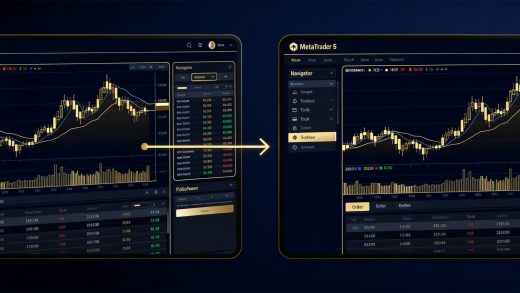
– MetaTrader 5 (MT5): The industry standard. Most brokers offer it. Huge ecosystem of indicators, EAs, and tools.
– MetaTrader 4 (MT4): Older but still very popular. Simpler than MT5 but fewer features.
– cTrader: Popular alternative, especially with ECN brokers. Clean interface, good for algo trading.
– Proprietary platforms: Some brokers have their own platforms. They can be good but you’re locked in — if you switch brokers, you have to learn a new platform.
Also important:
– Mobile app quality: You’ll check trades on your phone. Make sure the app is decent.
– Web terminal: Can you trade from a browser without installing software? Useful if you travel or use multiple computers.
– VPS support: If you use EAs (automated trading), make sure the broker supports or offers VPS hosting.
Factor 5: Deposit and Withdrawal Options
This seems basic, but it’s surprising how many brokers make withdrawals difficult or expensive.
What to check:
– Deposit methods: Bank wire, credit/debit card, Skrill, Neteller, crypto, etc. Pick a broker that supports methods you actually use.
– Withdrawal speed: How long does it take to get your money? 1-3 business days is normal for most methods. Anything longer than 5 days is suspect.
– Withdrawal fees: Some brokers charge withdrawal fees, especially for bank wires. A small fee is OK; excessive fees are a red flag.
– Minimum withdrawal: What’s the smallest amount you can withdraw?
Test early: After your first profitable month, make a small withdrawal. If it’s easy and fast, great. If it’s difficult or takes forever, that’s a warning sign.
Factor 6: Customer Support
You probably won’t need customer support very often. But when you do need it — during a technical issue, a withdrawal problem, an account question — you’ll really need it.
How to test support before you deposit:
– Send them an email with a question. How long does it take to get a response? Is the answer actually helpful?
– Try the live chat. Is there actually a person on the other end, or is it just a bot?
– Check their hours. If they’re only available during business hours in a single timezone, that could be a problem if you trade at odd hours.
Good support should be:
– Fast (respond within hours, not days)
– Knowledgeable (able to answer technical questions)
– Available in your language
– Available during the times you trade
Factor 7: Account Types and Minimums
Most brokers offer multiple account tiers. The question is whether the minimum deposit for the good account type is reasonable for you.
Common account tiers:
– Standard / Classic: Low minimum ($100-$500), higher spreads, no commission
– ECN / Raw / Pro: Higher minimum ($1,000-$10,000), tighter spreads, commission per lot
– VIP / Premium: High minimum ($50,000+), best spreads, personal account manager
Don’t stretch for a higher tier. If you only have $2,000, don’t deposit $10,000 just to get the ECN account. The slightly better spreads won’t make up for the fact that you’re trading with money you shouldn’t be risking.
Factor 8: Additional Features
These are the “nice to have” features — not deal-breakers, but things that can make a difference if you’re choosing between two similar brokers:
- Copy trading integration — if you want to copy other traders
- Social trading features — community, trader rankings
- Educational resources — for beginners
- Market analysis and research — daily/weekly market commentary
- Economic calendar — built into the platform
- Trading calculators and tools — position size calculator, margin calculator
- Demo account quality — some demo accounts are more realistic than others
My Broker Evaluation Checklist
Here’s a quick summary you can use when comparing brokers:
| Factor | Weight | What to Check |
|---|---|---|
| Regulation | Critical | FCA, ASIC, CySEC, CFTC — verify license number |
| Execution | Very High | ECN/STP, low slippage, no requotes |
| Spreads & Fees | High | All-in cost per lot on major pairs |
| Platform | High | MT5/MT4/cTrader, mobile app quality |
| Withdrawals | High | Speed, fees, method options |
| Support | Medium | Response time, knowledge, availability |
| Account Tiers | Medium | Minimum deposit for your preferred type |
| Extra Features | Low | Copy trading, education, tools |
Final Advice
Don’t pick a broker based on a flashy website or a big bonus offer. Pick based on safety, execution quality, and reliability. The broker is your partner in trading — make sure it’s one you can trust.
If you’re just starting out, open demo accounts with 2-3 different brokers. Use each for a week or two. See which platform you like best, which execution feels better, which customer service responds faster. Then pick one and fund a live account with a small amount.
Your broker choice isn’t permanent — you can always switch later. But starting with a good one saves you a lot of headaches down the road.
Have broker questions? Reach out on Telegram @DongyiTrade or email contact@dongyitrade.com. I’m happy to share my experience with different brokers and help you compare options.